Preheating and deaeration readiness
Preheating stabilizes the process before the final heat step. Some products also need air management to reduce oxidation, foaming, or inconsistent heat transfer.
 PILOT PLANTBeverage R&D Lab
RFQ
PILOT PLANTBeverage R&D Lab
RFQ
UHT Pilot Line
A UHT pilot line creates a controlled bridge between benchtop heating trials and full-scale aseptic processing. It helps teams validate heat load, holding time, fouling behavior, product stability, and cleaning routines before production investment.
Continuous or semi-continuous operation from small R&D batches to hundreds of liters per hour, depending on product behavior and utility availability.
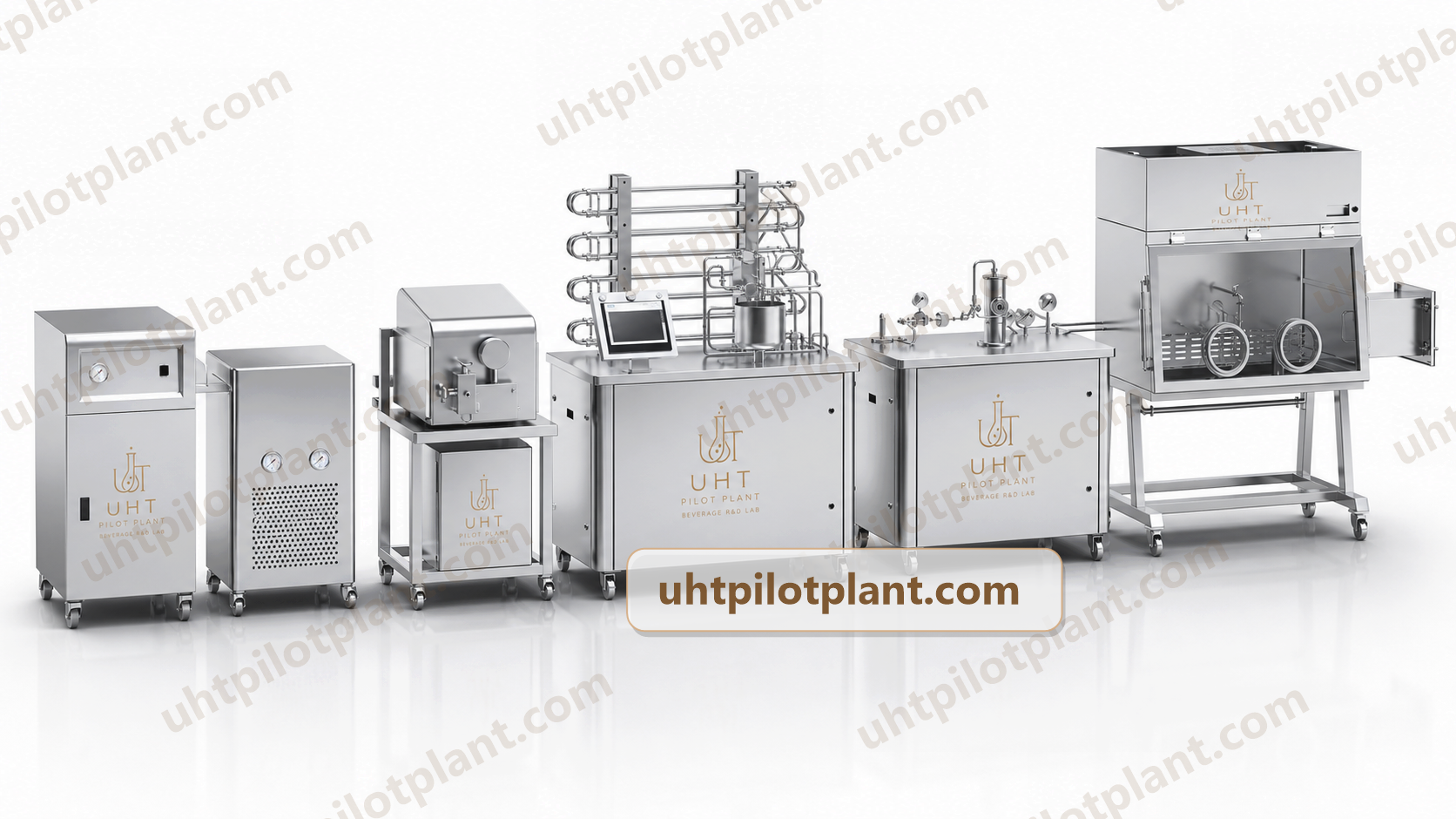
Line Architecture
The thermal section should be selected around the product, not around a generic flow diagram. Low-acid beverages, plant proteins, coffee, dairy, and sauces all place different demands on residence time, pressure drop, fouling, and cleaning.
Preheating stabilizes the process before the final heat step. Some products also need air management to reduce oxidation, foaming, or inconsistent heat transfer.
The holding section must deliver the target time and temperature profile with sensors placed for meaningful validation, not only for operator display.
Cooling strategy affects sensory quality, package compatibility, sample handling, and whether the trial can support early shelf-life screening.
Cleaning data, pressure trends, temperature recovery, and visible inspection points can be as important as the thermal result itself.
Validation Targets
UHT pilot equipment should generate process confidence. A good trial produces samples, but a better trial produces usable evidence for product quality, production design, and cleaning strategy.
Track color, flavor, protein stability, phase separation, sediment, viscosity, and heat-sensitive ingredient performance.
Monitor flow stability, pressure drop, heat recovery, holding time, pump response, and start-stop product loss.
Review CIP steps, chemical concentration, return temperature, conductivity, drainability, and inspection access.
Process Options
These configurations are starting points. The final system depends on product solids, viscosity, package plan, utilities, sampling needs, and whether homogenization belongs upstream or downstream of heating.
| Configuration | Best fit | Typical modules |
|---|---|---|
| Plate UHT pilot line | Low-viscosity beverages, dairy drinks, tea, coffee, and water-like products | Balance tank, feed pump, plate heat exchanger, holding tube, cooling section, CIP loop |
| Tubular UHT pilot line | Products with particles, fiber, higher solids, or higher fouling tendency | Positive displacement pump, tubular heater, holding section, back-pressure control, cooling |
| Inline homogenized UHT line | Dairy, plant protein, emulsions, fat-containing drinks, and texture-sensitive products | Preheat, homogenizer module, final heating, holding, cooling, sample outlet |
| Aseptic sample line | Early shelf-life trials and customer sample preparation | UHT section, sterile cooling path, clean filling zone, sterile sample handling, SIP-ready route |