Thermal validation
Sterilization temperatures up to 152 C with controlled holding and cooling routes for shelf-life and product quality studies.
 PILOT PLANTBeverage R&D Lab
RFQ
PILOT PLANTBeverage R&D Lab
RFQ
Thermal Processing System
A compact thermal processing line for UHT and HTST validation before production investment.
20 L/h and 100 L/h standard rated capacity options with configurable 5-40 L/h or 60-120 L/h process flow ranges.
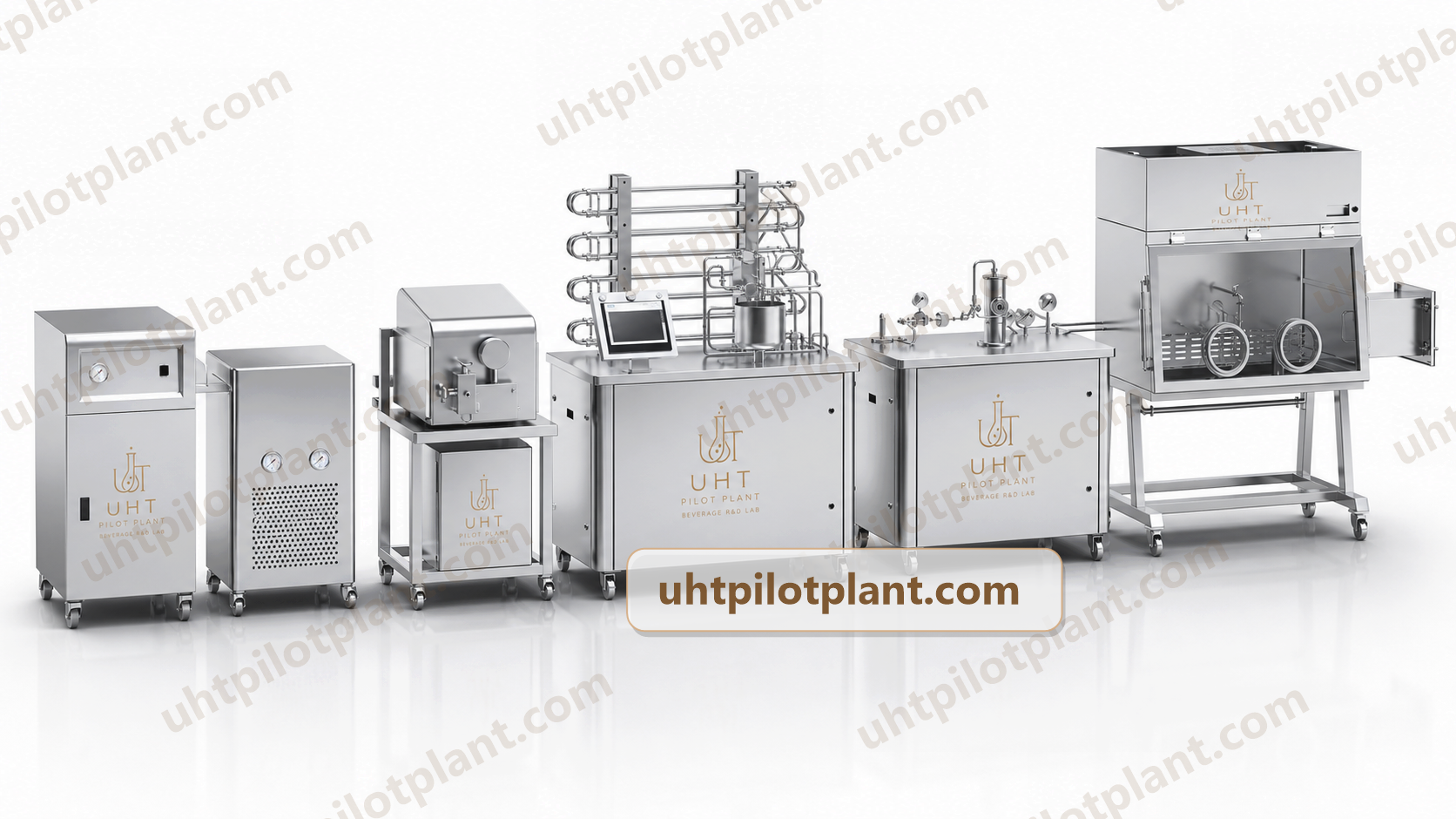
Equipment Role
This lab UHT/HTST pilot plant is designed for teams that need credible thermal process evidence from small batches. It supports sterilization, holding, cooling, optional direct steam injection, optional inline homogenization, and optional aseptic filling in a hygienic R&D footprint.
Sterilization temperatures up to 152 C with controlled holding and cooling routes for shelf-life and product quality studies.
Minimum batch sizes from about 3 L help reduce product loss during formulation screens and early process trials.
Touchscreen operation, data records, CIP, SIP, and hygienic product contact design support repeatable engineering review.
Configuration Notes
Strong equipment selection starts with product behavior, utility limits, cleaning expectations, and the measurements required for scale-up.
Define target temperature, holding time, final cooling temperature, and whether direct or indirect heating better represents the future process.
Viscosity, particles, fouling risk, protein stability, and sensory sensitivity should drive pump and tube selection.
Specify which trends, alarms, batch records, and sample points are required for internal approval.
Technical Snapshot
Values below are typical catalog-derived ranges and should be verified against the final process scope, product risk, and utility environment.
| Parameter | Typical specification |
|---|---|
| Rated capacity | 20 L/h and 100 L/h standard configurations |
| Process flow | 5-40 L/h or 60-120 L/h optional ranges |
| Minimum batch | Approximately 3 L, depending on line configuration |
| Sterilization temperature | Up to 152 C |
| Maximum pressure | 10 bar typical process design limit |
| Product viscosity | Up to 6000 cPs, subject to pump and heat exchanger selection |
| Heating tube ID | 8 mm or 10 mm options |
| Product contact material | SS316L |
| Options | Direct steam injection, flash cooling, inline homogenization, aseptic sample filling, CIP, and SIP |
Applications
Use these application routes as starting points, then refine the configuration around viscosity, particles, heat sensitivity, oxygen exposure, and cleaning difficulty.
Lab UHT/HTST Pilot Plant can be configured to support uht milk and dairy drinks trials with controlled process conditions and sample collection.
Lab UHT/HTST Pilot Plant can be configured to support plant-based beverages trials with controlled process conditions and sample collection.
Lab UHT/HTST Pilot Plant can be configured to support coffee and tea beverages trials with controlled process conditions and sample collection.
Lab UHT/HTST Pilot Plant can be configured to support nutritional drinks trials with controlled process conditions and sample collection.
Lab UHT/HTST Pilot Plant can be configured to support acidified products trials with controlled process conditions and sample collection.
Lab UHT/HTST Pilot Plant can be configured to support ingredient thermal validation trials with controlled process conditions and sample collection.
RFQ
Prepare product type, batch size, target throughput, temperature or pressure range, cleaning requirements, utilities, and the data you need from the trial.
A concise RFQ brief helps turn this equipment page into a usable configuration discussion.